I’ve been to a lot of meetings and workshops where my biggest question is: Why are we here? Many times the person calling for the meeting has not taken the time to clarify what they want out from it nor why it is important to do this now. They either expect people to understand it by themselves, or don’t realise it is important.
Most people usually take the time to write a short headline or an agenda. But neither of those answers the real questions that are on people’s minds:
- What is the problem we are solving by this meeting?
- Why is it important?
- What do you expect from this meeting?
- What do you expect from me?
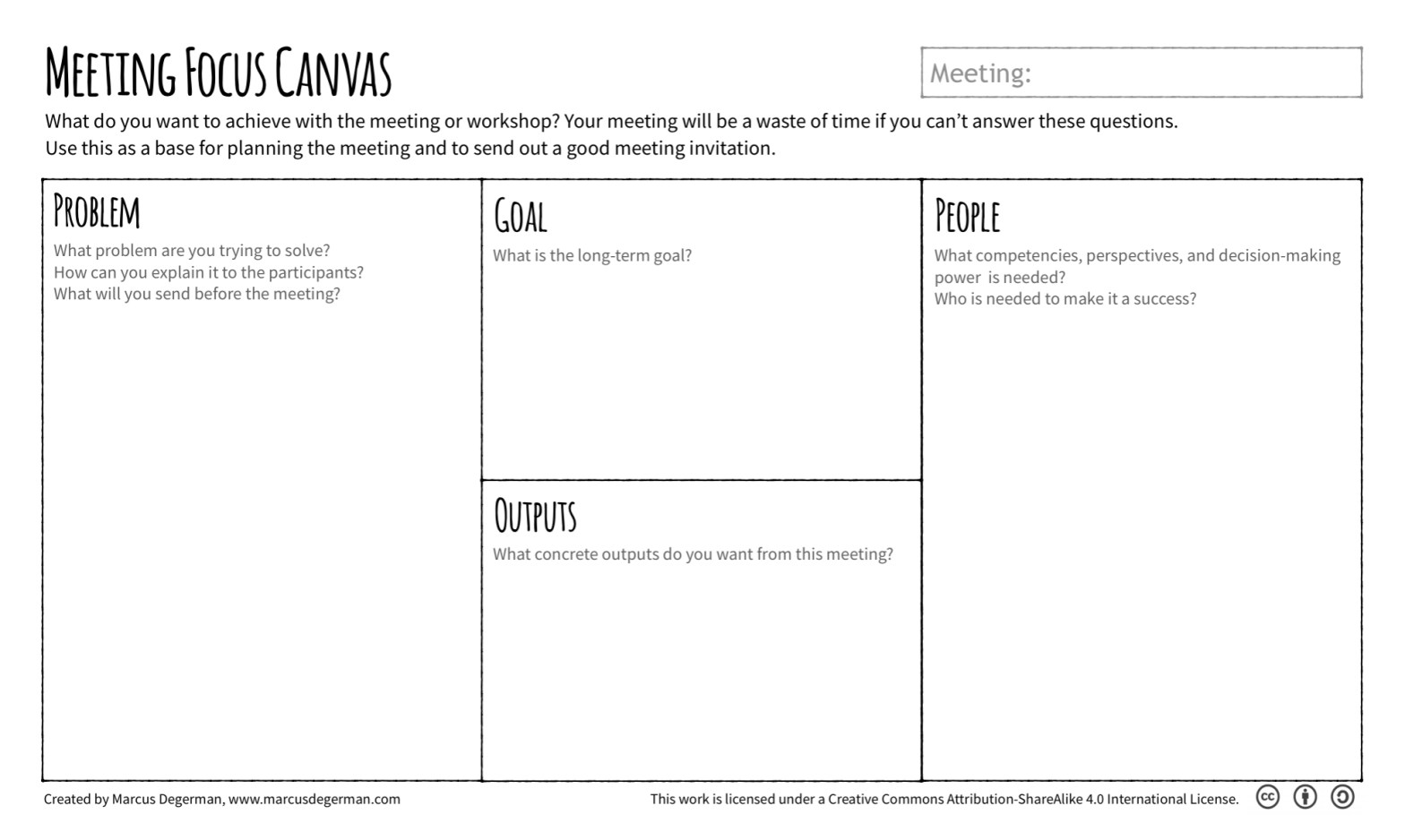
I have developed the Meeting Focus Canvas to help people think about these questions and remember to communicate them. It is a visual tool to help you co-create what a meeting is all about. The questions in the canvas have helped many teams improve their meetings, and clarify to one another why they meet and what their focus is.
You can work on the canvas in any order but I have often found it helpful to start by first defining the Problem and the Goal. After this I define the Outputs, and with this in mind I start thinking about who to invite: If we have this problem today and if we bring these People into a room then we will create the outputs and reach the long-term goal or strategy.
Meeting Focus Canvas
Problem
- What problem are you trying to solve? Try to describe the problem in a few sentences or use sticky notes if you draw the template on a white board. If you end up with a lot of problems to be covered then try to prioritize so the scope does not get too big.
- How can you explain it to the participants? Are all participants aware of the problem and its context? Are there some parts that everyone needs a deeper understanding of? How can you visualize the problem in a good way?
- What will you send before the meeting? What information should be sent out before the meeting so that people can prepare.
Goal
- What is the long-term goal? Why is the problem important to solve and what organizational strategies or goals are we supporting by solving it? We need to make sure we solve the problem in a way that benefit the rest of the organization and not just solve the short-term problem.
Outputs
- What do you want from this meeting? What concrete outputs do you want from this meeting. The more outputs you have or the more abstract they are, the longer the meeting will have to be. It is often better to define a few concrete outputs and have a first shorter meeting, instead of trying to solve everything at once.
People
First think about what competencies, perspectives, and decision-making power you want in the room. And then think about the people who can fulfill these:
- Competencies What knowledge or expertise do we need? Any special skills that would help the meeting forward?
- Perspectives What perspectives, experience, or roles do we need in the meeting to make sure we look at the problem from all relevant directions?
- Decision-making power Who needs to be in the meeting to make the necessary decisions? If we don’t have those people in the room, then the outputs of the meeting will have to be crafted as suggestions to someone who can make the decision.
Try to limit the number of people in the meeting, the more people you have in the meeting the harder it will be to facilitate and the longer it will take. If you go above six people in the room, the meeting will be harder to facilitate. Read more about this in the chapter People in the book or in this short blog post.
In an upcoming posts I will share examples and more ways you can work with it.
—
You can download the Meeting Focus Canvas and other tools here.
To keep up to date with what is happening you can follow my facebook page here.

 Marcus Degerman